

Always Edythe
Part one: Good, and then some
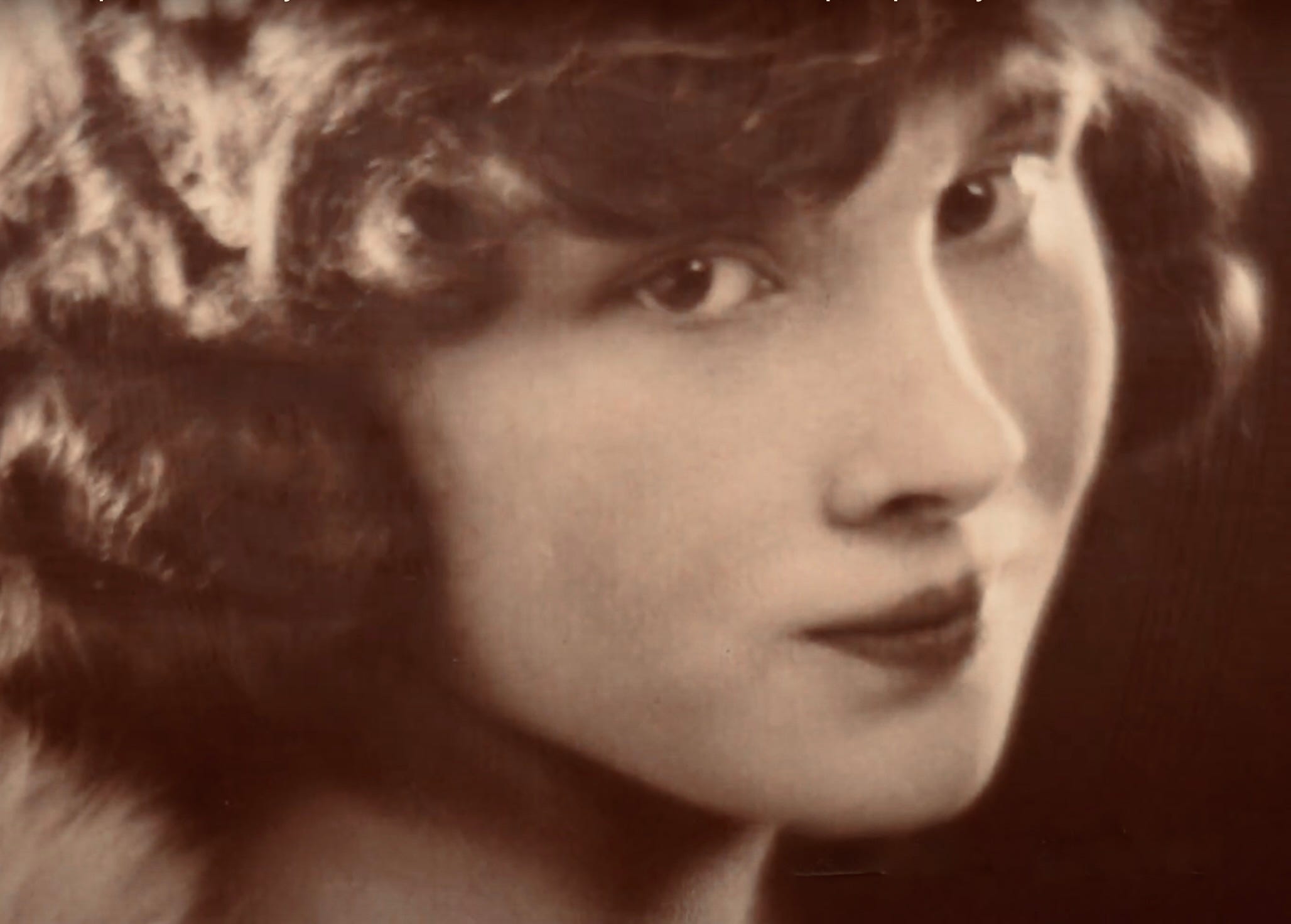
If you happen to be downtown on a lovely Saturday in early April 1920, strolling along Walnut street under the striped awnings of the J.W. Jenkins Sons’ Music Company, the sound of an enthusiastic piano might cause you to halt outside the door. Someone really knows how to lay down ragtime.
Nowhere else a display of pianos to equal ours, Jenkins ads boast. Top brands, including the Aeolian company’s “Incomparable Duo-Art.” All the beautiful old time songs are in your repertoire if you have an Aeolian Player Piano.
Peering in through plate glass you see, sure enough, a Duo-Art cranking out not a beautiful oldie but this new rag you haven’t heard. The song ends. The roll flaps. A petite young brunette climbs onto the bench and sets fingers flying across the keyboard. The exact same tune. Note for note, without sheet music.
Afterward, the sales clerk speaks your mind. There is positively no way to tell which is Miss Baker in charming person and which is her proxy on the Duo-Art.
Were you to ask, you’d learn Miss Baker’s first name – Edythe – and the piano roll is Edythe Baker’s artistry. She’s twenty years old, from Kansas City, left town about a year ago, has been in New York the past several months. Here this week visiting her mother and friends, now and again popping into the Jenkins store.
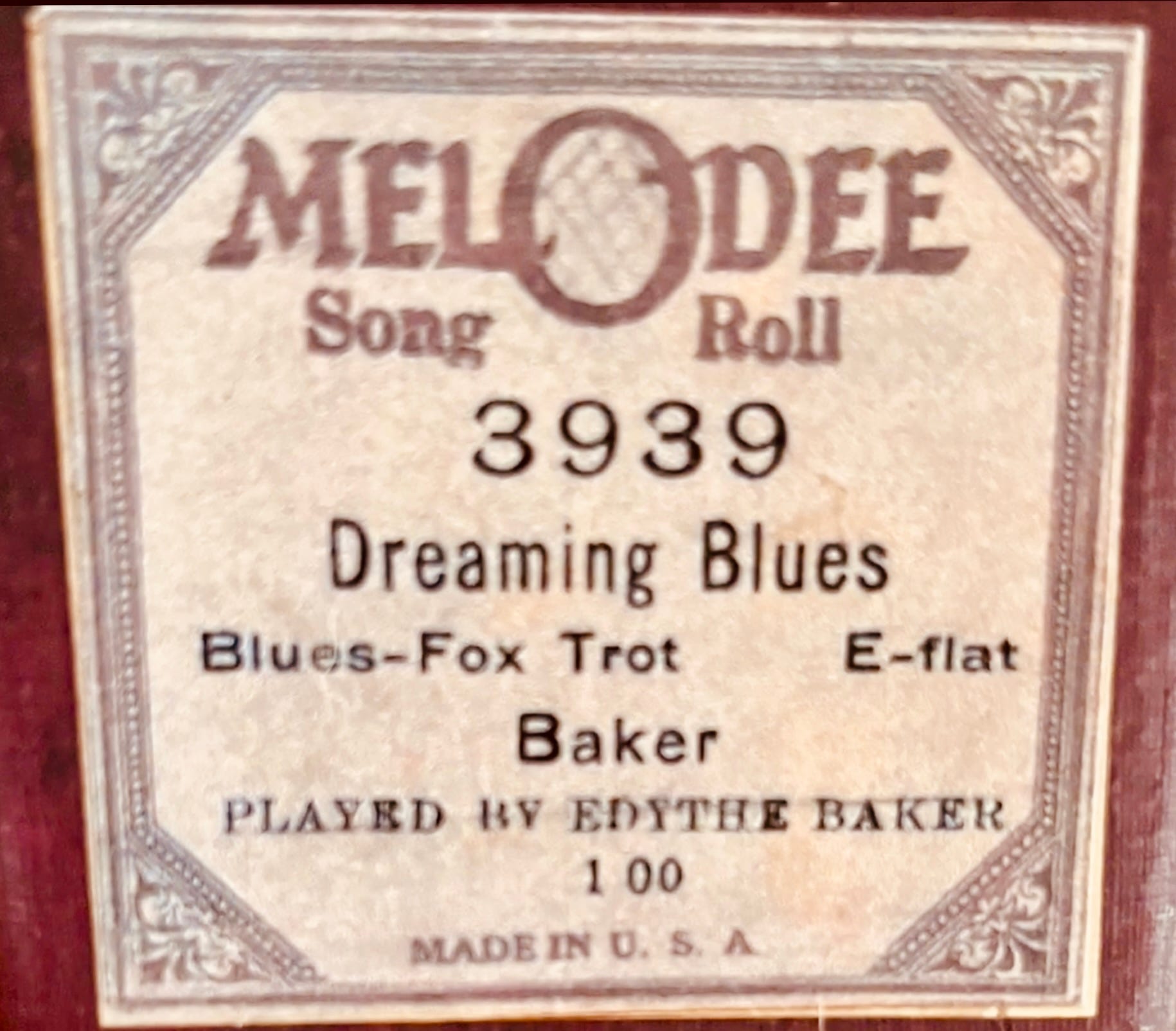
Sunday morning, reading the arts page in the Journal, you’d learn Edythe Baker makes popular Mel-O-Dee piano rolls for the Aeolian company, composes syncopated music, has been headlining on the Keith vaudeville circuit back east, and “has ten ‘jazz’ fingers which simply will not behave.”
Also that “In her vivacious way, this charming little musician is a genius.”
* * *
Time passes. Every so often Miss Baker reappears in the newspapers.
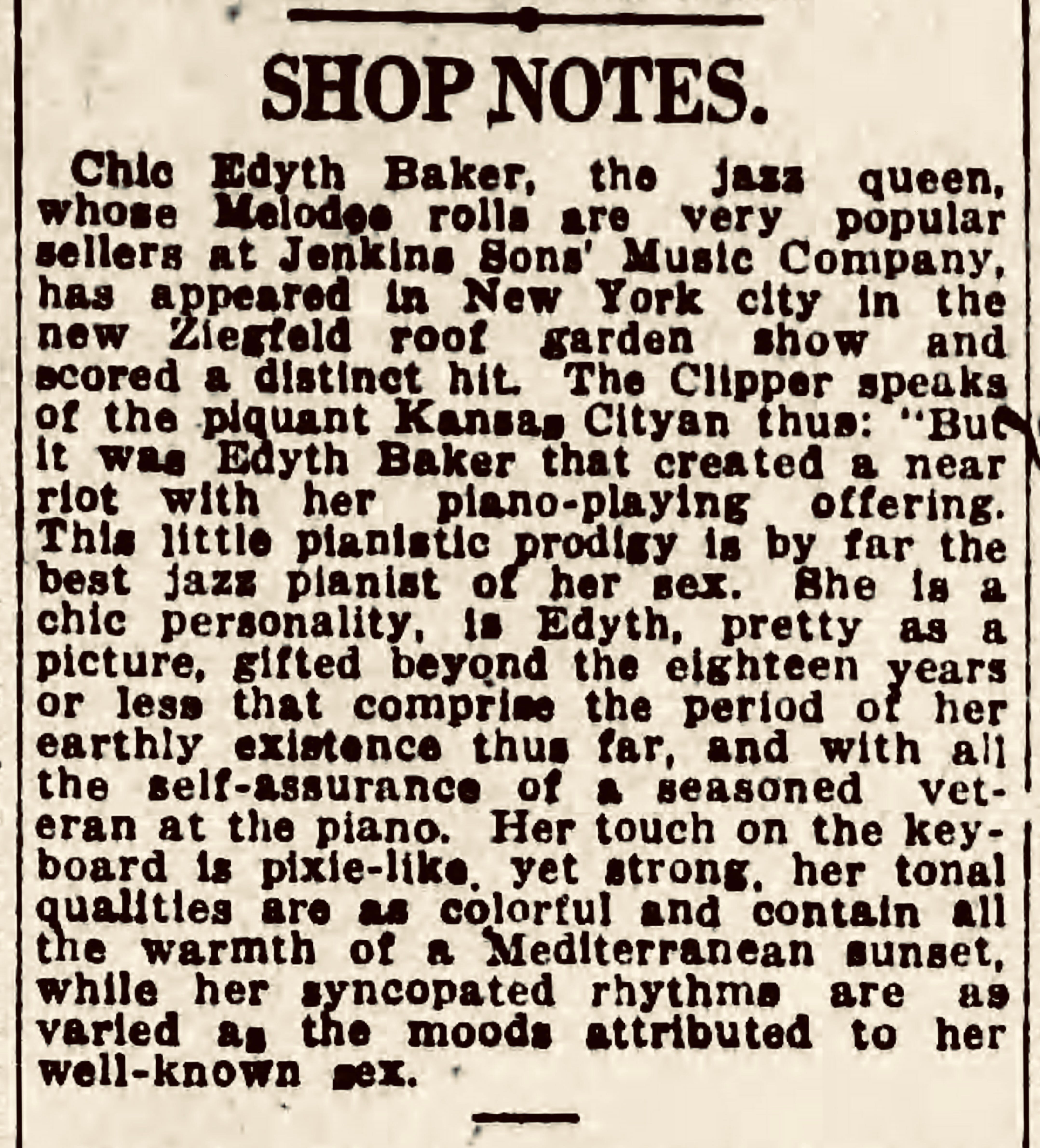
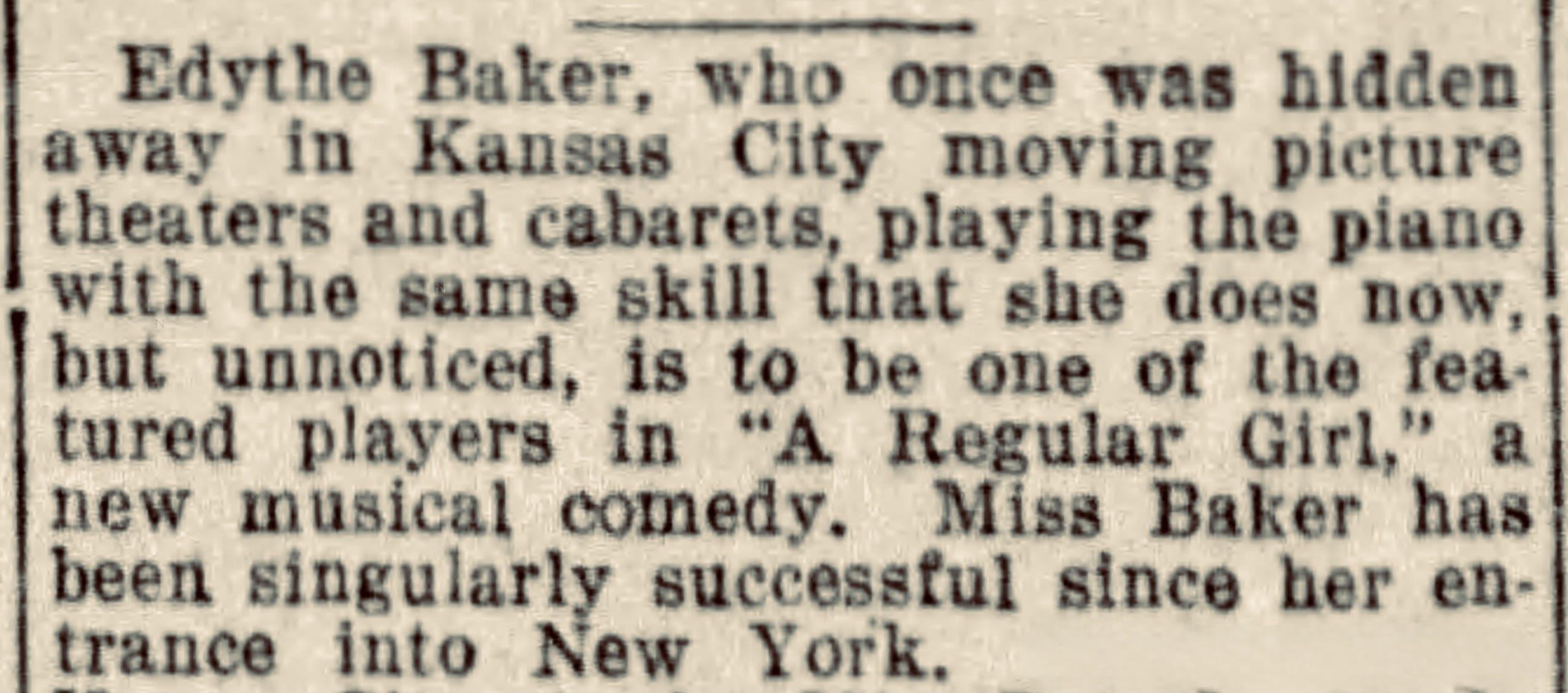
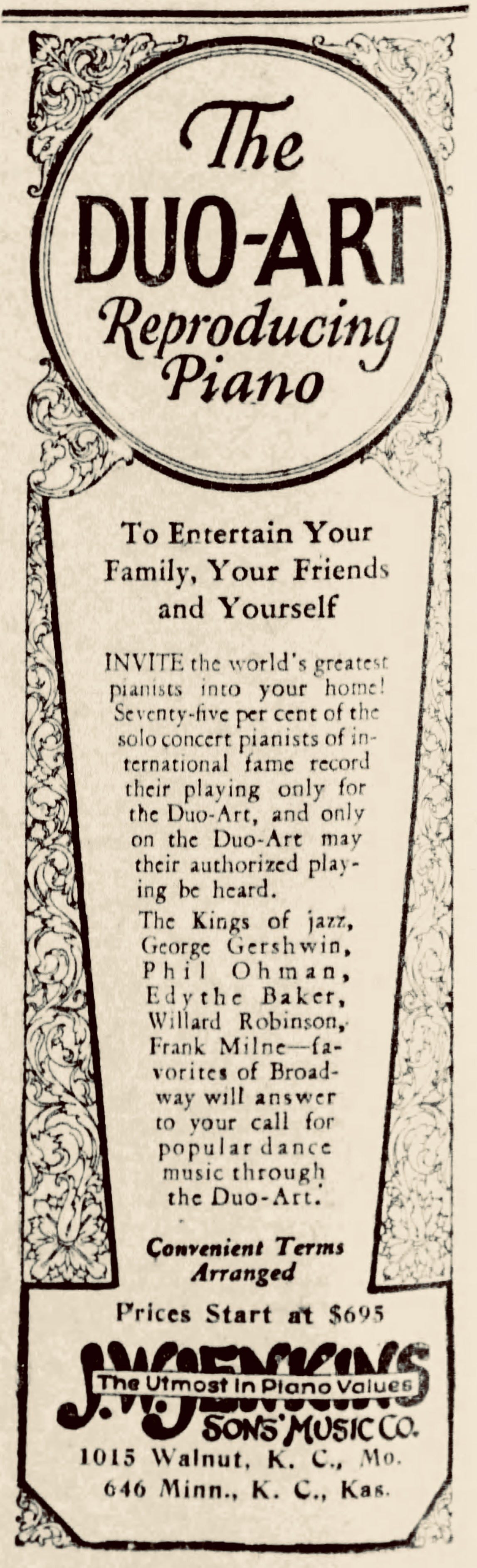
Then comes a warm autumn Friday in 1927, and this item:
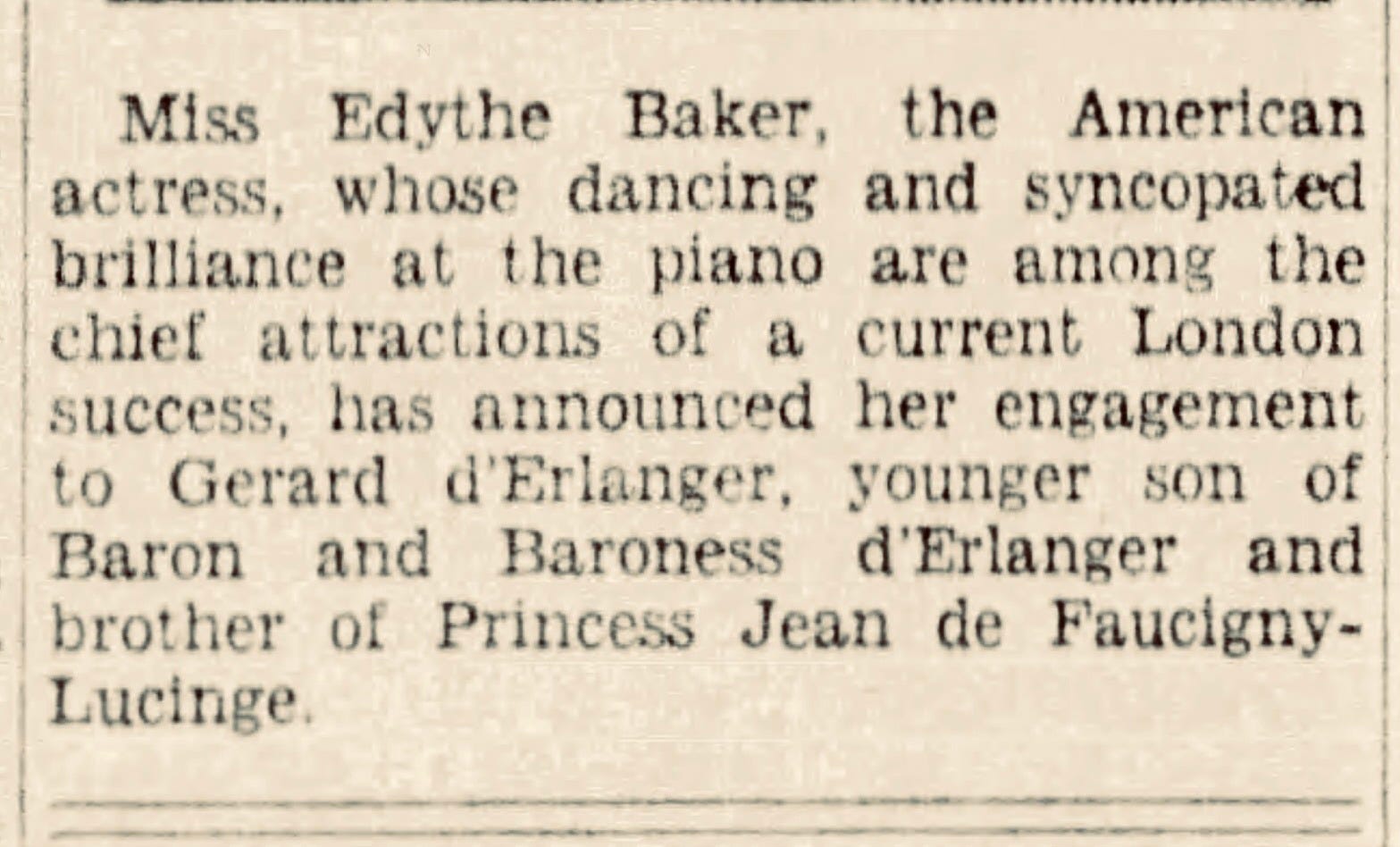
* * *
Edythe Baker’s life – or at least one of her many lives – was a cinematic fairytale.
Today, she’s remembered primarily by music historians. They tend to focus on her ascendance as a popular pianist, a petite beauty with a pleasing disposition. That story usually begins with her New York arrival in 1919 and ends with a marriage proposal in London. It’s filled with piano rolls, vaudeville, the Ziegfeld Follies, Broadway, 1920s musical luminaries like George Gershwin, Al Jolson, the Astaire siblings, Fred and Adele.
There’s Edythe, spinning syncopated magic from her trademark white grand. Writing tunes, singing, dancing and telling stories in “pianologues,” dressed in colorful silks, satins, rhinestones, ostrich feathers. Performing on the latest thing – a radio broadcast – billed as “America’s greatest jazz pianist.”
Her contemporary reviewers called her “a pianiste of rare ability” who “just rags it silly” and “makes it difficult for the audience to keep their feet still.” They couldn’t resist adding she was “strikingly good looking” or a “beautiful little person” or a “quite stunning looking pianist” from Kansas City. Especially after she traded her schoolgirl tresses for a stylish bob.
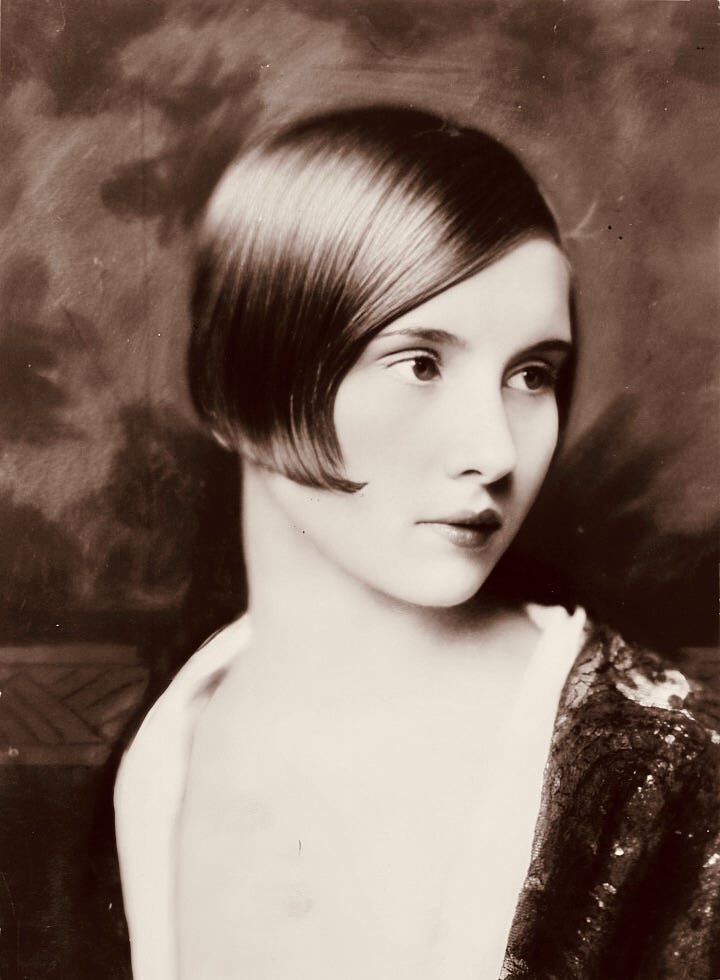
Amazing, yes. There remain a few dots to connect to get to a British high-society wedding engagement.
* * *
You can bet Edythe attracted male attention in New York, some of it the unwanted type. A piece of her story that’s often missed or glossed over is the early backstage meeting with Walter Kingsley, a press agent for Florenz Ziegfeld. Whatever his true motive, Kingsley got her an audition with Ziegfeld. Then he told her that if she would follow his advice, he could guarantee fame and fortune.
“I have given the same advice that I gave to Edythe Baker to at least one hundred other girls,” Kingsley later recalled. “But she was the only one who ever had the determination to carry through the plan.”
In addition to hours of daily piano practice, she followed Kingsley’s rules: Live in a good hotel, even if it means eating less often. Be seen with people of high character, or stay home and read. Visit only the best night clubs, go late to appear fresher than other women, stay a short time.
Kingsley eventually introduced Edythe to society matrons, who loved her. She entertained at their soirees, learned to play contract bridge, played after hours in their favored speakeasy. Then, in 1926, she sailed to Europe. In Paris, at a party, she met Edward Windsor, the Prince of Wales.
“I was so mad to see the Prince, for I had heard so much that was charming about him from friends in America,” she told a reporter in England. “The Prince danced six times with me, and was awfully keen to learn the Black Bottom, so I taught him. Then, of course, I was asked to play, and I played for forty minutes and the Prince enjoyed my playing immensely.”
In London she was cast in a new revue at the London Pavilion, music by a young Broadway songwriting team, Richard Rodgers and Lorenz Hart. Opening night, May 20, 1927, the Prince and his entourage looked on as she took center stage seated at her white grand. The reviewers raved :
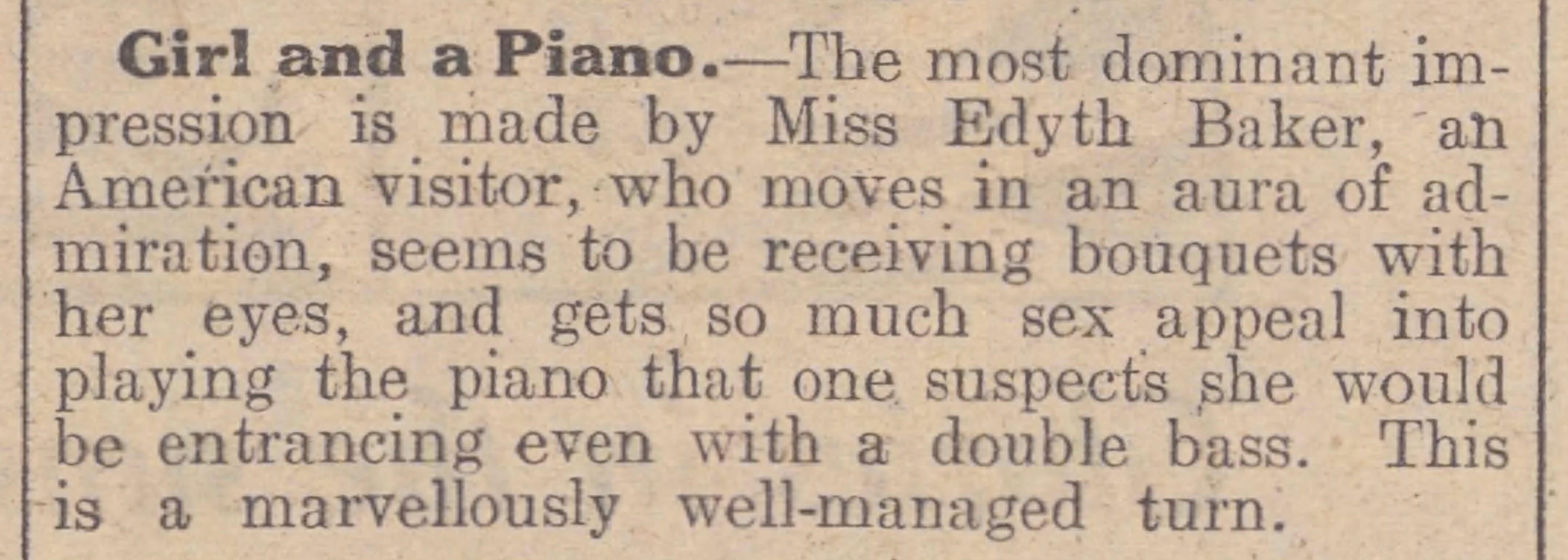
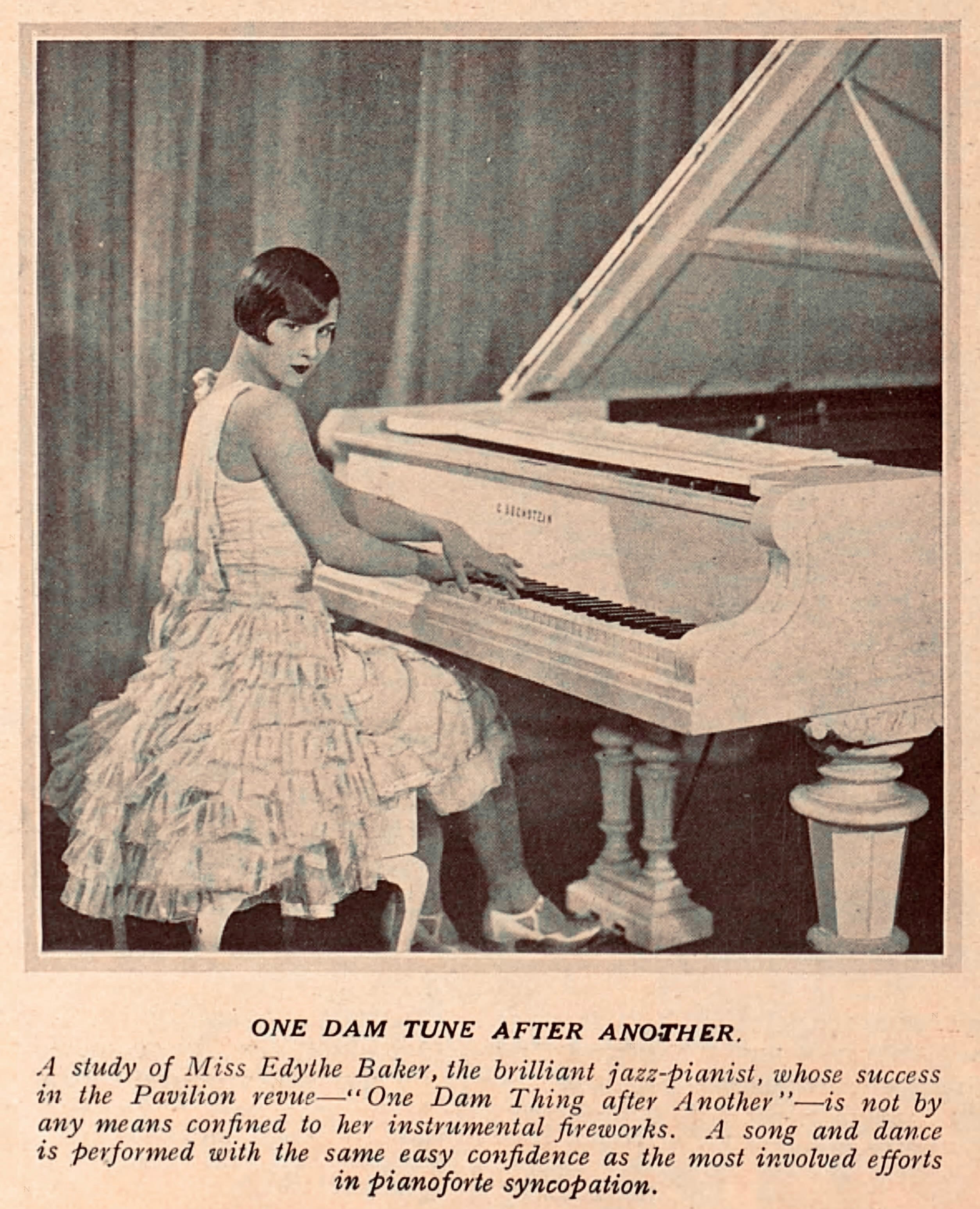
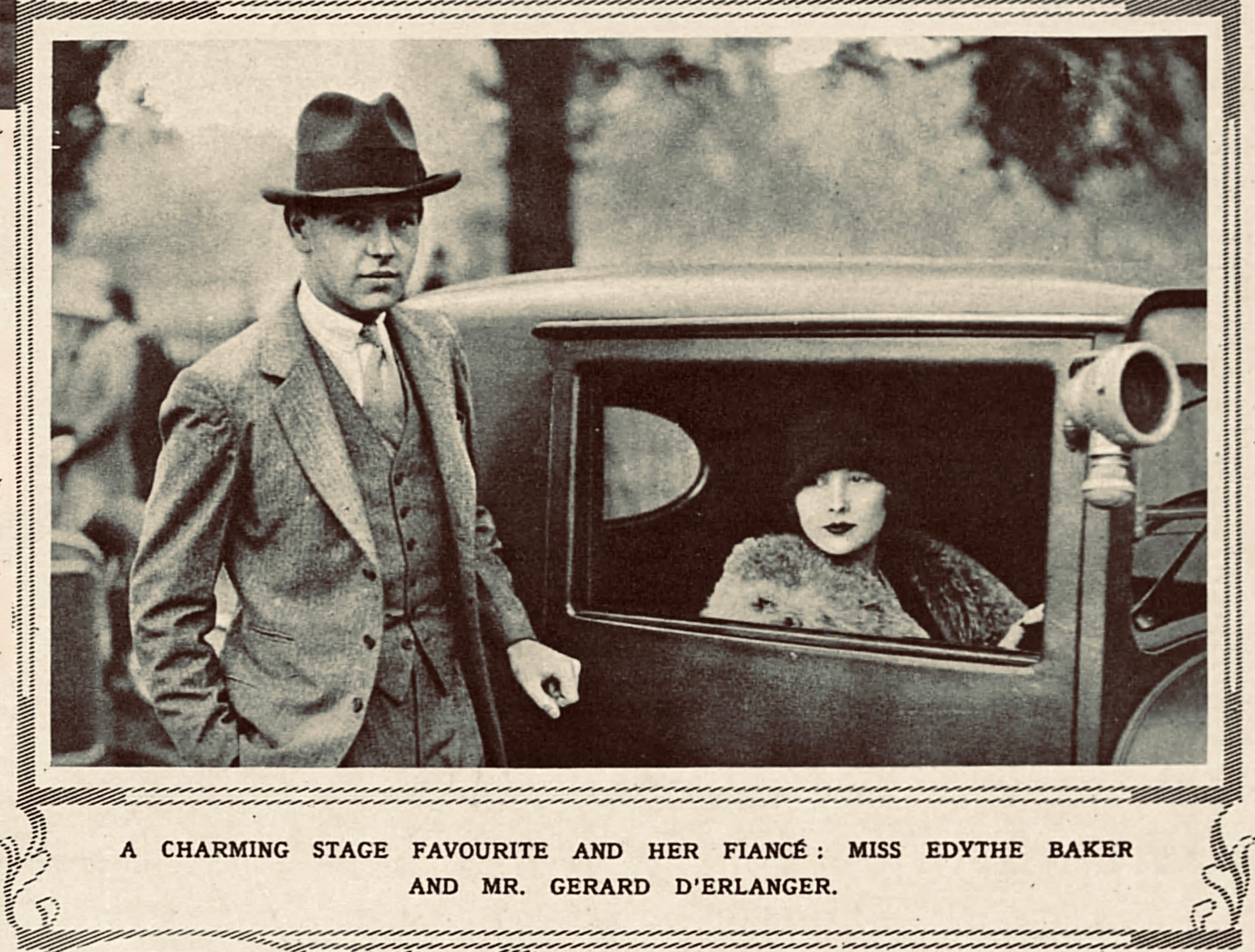
The princely circle included the tall and handsome Gerard d’Erlanger, son of Baron Emile d’Erlanger, a financier of railways in colonial Africa among other things. Playing bridge together led to a summer romance of exotic travel, adventure and, in September, a marriage proposal.
* * *
Some weeks later the United Press reporter in England interviewed Edythe, then still starring in the Pavilion revue. The writer, probably already aware of her background, aimed to flesh it out. When his story clacked out of the teletype down at the Kansas City Journal, the local U.P. franchise, the city editor probably dropped his cigar:

A Journal reporter hustled downtown to find his man.
“Do I remember Edythe Baker?” exclaimed Joe Donegan, ever wistful since Prohibition had killed off his cabaret. “Why, I raised her!
“She was with me at the start of the World War in 1916 and 1917,” he said. “Old timers will remember her and the personality that brought more than one encore to her pianologues. She was such a good kid. I remember she helped raise a kid brother. Put him in school, cared for him on what she made at the Edward grill.
“I’m not surprised she got to the top of the ladder. She deserved it.”
* * *
Romantic partners usually want to know more about each other’s past. They tell stories about themselves, their families, their origins. There’s reason to wonder how much history Edythe Baker was willing to share with blue bloods from the Upper East Side or Mayfair.
“I did begin to play the piano when I was three years old,” she once told a New York reporter. “I took to the piano like the proverbial duck. And there I played and played. Not wonderfully, but it did me a lot of good.”
She didn’t mention that the year she was three, in the southeast Kansas town of Girard, her mother left her father, taking Edythe and her younger brother, Cecil, dropping them at her mother’s house before disappearing. Their father, Asa Baker, an itinerant laborer, won a divorce and custody, declaring Gertrude an unsuitable mother.
Somewhere there must have been a piano for a three-year-old to bang on, a tool of expression for whatever she was feeling. Or not feeling.
Both Asa and Gertrude remarried multiple times. When Asa’s second wife died in 1907 he had to reevaluate Gertrude’s fitness for motherhood. She had resurfaced in Kansas City and married a plumber. It was decided Cecil would stay with his father, by then a brickyard worker in Humboldt, Kansas. Perhaps because a budding musical talent had bloomed, or because young girls need a mother, 8-year-old Edythe would go to Kansas City, where Gertrude and her husband lived in a rooming house, and attend St. Mary’s Academy in Independence.
Gertrude’s second marriage soon failed. She wed again, a dentist with a drinking problem who left her three days later. Just before Edythe’s 1920 visit, Gertrude won a divorce from him. But court testimony cast her as someone familiar with alcohol, drugs, adultery and blackmail.
* * *
St. Mary’s was a boarding school promising a “unique plan for the symmetrical education of young ladies.” It offered extensive musical training, including classes honing what would later be called her “sweet, natural soprano voice.”
After six years at St. Mary’s, she shared a series of apartments with her mother, who worked as a store clerk. Edythe, probably seeing a need to help support her mother, advertised herself as a piano teacher, but landed a job with George “Nowlin the Piano Man” at his downtown music store.
Nowlin’s was among two dozen piano dealers clustered around Eleventh and Walnut, also selling “talking machines,” phonograph records, sheet music. Up and down Twelfth street the air was heavy with ragtime, like Euday Bowman’s “12th Street Rag.” And new “blues” music, a Southern cousin of ragtime, as in W.C. Handy’s “Memphis Blues” and “Yellow Dog Rag.” Not the type of music heard or played at St. Mary’s.
In 1915 Nowlin told a trade journal Edythe was “an accomplished musician” and “very expert in the handling of customers in the talking machine department as well as in the piano department.” But she wanted more, and talked her way into a gig at the Alamo Theater, 34th and Main, playing accompaniments and interludes for silent pictures. Patrons took notice.
At some point she decided to go see a man she’d heard about, the “Angel of Twelfth Street,” who ran the most popular cabaret in town. The house pianist there, Ernie Burnett, had written “My Melancholy Baby” a hit tune of 1914. Walking into the Hotel Edward, Twelfth and Central, she asked Joe Donegan for a job. She was 16 years old.
* * *
It’s possible Edythe exaggerated her circumstances to Donegan, a man said to never refuse someone in need. The way he told it, she had no musical training, was homeless and penniless with a dependent mother and brother. He said she learned fundamentals from Burnett. Donegan’s account could be the source of inaccurate future reports – that she was entirely self-taught, never took a lesson, played by ear, learned by watching professionals.
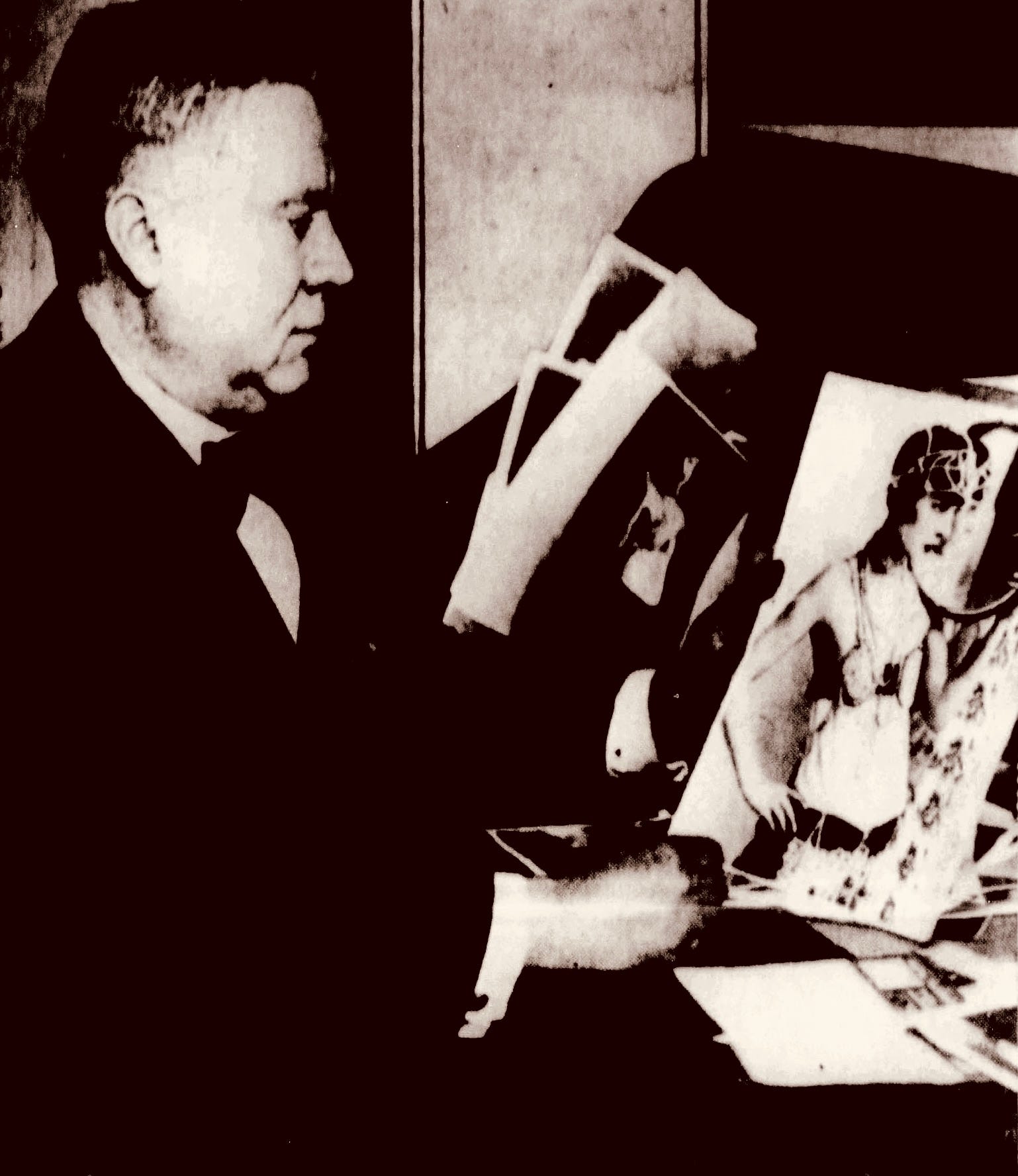
Decades later someone who heard her play in Kansas City remembered her style being 50 years ahead of the times. One critic found it a fresh brand of syncopation, played “with much more artistry than most performers of this type.” Another called her “a little virtuoso, whose right hand is the artist and her left a clown – swooping down on the keys like a bolt from the blue.”
“At the end of 14 years of practicing I reached the ‘promising’ class,” Edythe later recalled. “In another year I graduated from ‘pretty good.’ And when I stepped into that era of life known as ‘sweet sixteen’ I was called ‘good’ and then some.”
She still lived with her mother, but often rode the train to visit her remarried father, in Humboldt, where she sometimes performed for childhood friends. In about 1917 Asa Baker moved to Kansas City, Kansas, for a lumber-yard job. Brother Cecil, then about 16, apparently enrolled in the Lathrop School, a couple blocks from the Hotel Edward. Lathrop was a vocational school considered a harbor for troubled youths.
* * *
Donegan may not have raised her, but he did raise her chances of success. The Edward’s guest register contained signatures of touring theatrical folk. And working with a musical pro like Ernie Burnett was surely a plus. Her pleasing manner and unusual style wowed patrons.
No doubt she first realized her “superpower” at the Edward grill. The stage, the fawning audience, the sudden possibilities for whatever dreams she held close.
Irving Mills was a talent scout who later managed Duke Ellington. “During my early days I was in Kansas City checking out piano players, seeing how they were doing,” he recalled. “There is one girl who can play anything that’s put in front of her. Her name was Edythe Baker. I listened to her and told her that anytime she came to New York, she’d have a job.”
When America entered the European War, the Army contracted to build an entertainment zone outside its Camp Funston near Junction City, Kansas. Officials asked Donegan for musical talent. Burnett got the job. So did Edythe.
“I only played in Donegan’s about five weeks,” Edythe would recall. “when a better offer came along and I grabbed it.”
One soldier training at Funston was Robert Russell Bennett, who later orchestrated music for Irving Berlin, George Gershwin, Cole Porter and others.
“We went in to hear her one evening,” he would recall. “and I don’t believe Josef Lhevinne or Vladimir Horowitz could ever have played the ‘Twelfth Street Rag’ in octaves faster or more cleanly than she did. It took my breath away.”
In May 1919, a touring vaudeville show at Kansas City’s Empress Theater featured a young singer named Willie Smith. A month later, Smith was singing in Louisville with a new accompanist. Edythe Baker was on her way to New York.
* * *
After her matrimonial intentions were announced in September 1927, Edythe spoke about her fiancé to a London reporter.
“He has been to the theatre where I am playing only two or three times,” she said. “I do not believe he is very keen on seeing me act. When we are married I shall give up the stage. We both agree on that.
“Am I sorry to leave the stage? Well, I shall not be.”
* * *
Next in part two: One life ends, another begins.
* * *
I like the way you segue through the storyline.